How Long Does a Custom Oil Painting Take from Brief to Arrival?

I can plan a portrait for a gift and mistake painting time for arrival time. The gap creates stress. I build the schedule around every required stage.
I plan a custom oil painting around brief review, composition approval, painting, drying assessment, finishing, packing, transport, and any local preparation. I ask for an order-specific schedule and share the required arrival date. I do not treat touch-dry paint or a fast listing promise as a universal delivery timetable.
I use a schedule to reveal decisions rather than to invent an exact number of days. I check what starts each stage, what can delay it, and who needs to respond.
Which stages belong in a realistic artwork schedule?
I can ask only when the artist will finish painting. That leaves several later tasks unplanned. I include the whole route before I agree to a deadline.
I include brief review, reference and composition approval, production, drying assessment, finishing, final review, packing, shipping, and local preparation where needed. I ask which stages can overlap and which depend on earlier approval. I separate an estimated schedule from a confirmed arrival commitment.

I start the clock with a clear brief
I ask what information the supplier needs before the schedule begins. The artwork reference, size, quantity, medium, finish, destination, and approval route can all affect the plan. I do not count a vague first inquiry as the start of production. I wait until the brief is clear enough for the maker to assess the work.
I also ask what booking or order confirmation is required. I keep commercial terms in the quotation rather than assuming that a saved inquiry starts the artist's work. I want both sides to know which event starts the next stage and which decisions remain open.
I map the steps that cannot be skipped
I write the stages in order and identify their handovers. An early composition review can prevent a later correction to a painted face. A finish decision can change packing dimensions. A final approval can affect the dispatch date. I do not use a short production estimate to cover these separate tasks.
| Stage I include | Start point I confirm |
|---|---|
| Production | I confirm the approved brief and order. |
| Finishing | I confirm the surface and finish readiness. |
| Dispatch | I confirm final review and packing. |
A Reddit gift commission with a short deadline shows why the desired date needs to appear in the first brief.[1] I use that concern to plan backward. I can begin with XM's custom artwork service, but I ask for the schedule for my selected work rather than a blanket production promise.
Why is touch-dry paint different from readiness for finishing or shipment?
I can hear that a surface feels dry and assume it is ready for every next step. That assumption can rush the order. I ask the maker to assess readiness.
I treat touch-dry as one surface condition, not proof that every oil-paint layer has finished changing or can accept every finish and packing method. I ask the maker to assess the selected materials, thickness, and next step. I do not test the surface by touching it myself.

I keep the material question specific
I ask which medium the order actually uses. I do not apply an oil-paint schedule to an acrylic or mixed-material design simply because a listing groups them together. I also ask whether the selected surface has thin layers, substantial relief, or another feature that changes the maker's assessment.
Gamblin explains that oil paint dries through oxidation and that the process continues after it becomes touch dry.[2] I use that basic distinction to avoid demanding a universal drying deadline. I do not turn it into a fixed waiting period for every artwork. The maker knows the actual materials and layers in the selected piece.
I ask what readiness means for the next step
I ask separately about finishing, packing, and shipment. A surface can be ready for one task and still need a different decision before another task. I want the supplier to explain which stage controls the next handover. I avoid asking for a faster finish that could create a new handling concern.
| Question I ask | Decision it supports |
|---|---|
| Which medium is used? | I choose the right schedule discussion. |
| Which surface is planned? | I identify the relevant production risk. |
| What happens next? | I ask for the correct readiness check. |
I leave technical treatment and handling to the maker or a qualified specialist. I do not put fingers on the paint to confirm a delivery promise. I keep the approved surface and finish in the order record so the timing discussion refers to the same work throughout production.
How do approvals and revisions change the arrival plan?
I can delay a review without realizing that the schedule depends on my response. The order then feels late. I agree on review timing and feedback before work starts.
I ask when reviews are expected, how quickly I need to respond, and which changes remain possible at each stage. I confirm whether new requests add cost or time. I use one clear feedback record and update the arrival plan when the approved scope changes.

I reserve time for my own decisions
I note when the artist expects a composition or final review. I tell the supplier if I will be away or unable to respond promptly. I do not assume that a production schedule continues unchanged while approval is pending. I ask how a delayed response affects the next step.
I also define who can approve the work. A personal gift may have one decision-maker. A hotel project may involve a designer, owner, and purchasing team. I want one agreed route for collecting feedback so the artist does not receive conflicting changes from several people at once.
I separate correction from a new request
I use the approved brief to judge the review image. I can point out a mismatch in the agreed crop or a key portrait feature. I treat a new background, another person, or a different size as a scope change that may need a revised quote. I do not assume that every later preference belongs to the original revision allowance.
| Review detail I agree | Delay I reduce |
|---|---|
| Decision-maker | I avoid conflicting approvals. |
| Response window | I avoid an unknown waiting period. |
| Change scope | I avoid an unplanned new task. |
I ask for a revised schedule when a change is approved. I keep the new dates and scope together so an older message does not remain the apparent promise. I use the process to make the order clearer, not to pressure the maker into hiding uncertainty behind a confident date.
How do I plan a gift date or project opening without guessing?
I can leave shipping until the painting is complete. That approach hides destination and preparation needs. I work backward from the date when the artwork must be usable.
I state the required arrival date, destination, quantity, and final delivery format at the start. I allow for inspection, local framing or installation, and review time. I ask whether the proposed route supports that target and agree on any alternative before approving production.
I distinguish arrival from readiness to display
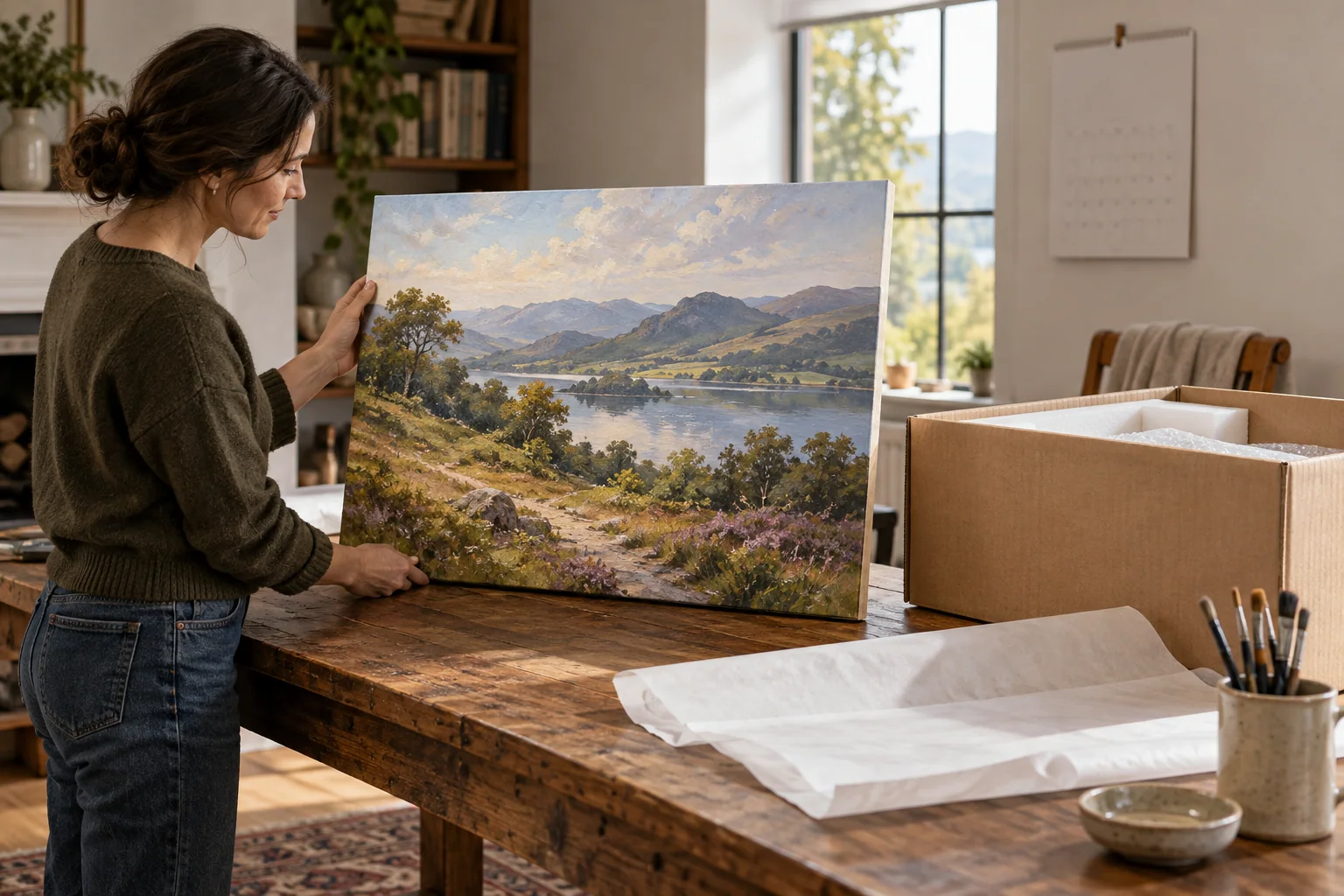
I ask whether the work arrives rolled, stretched, or framed. A rolled canvas may need a local framer's time before I can give it as a ready-to-hang gift. A large framed piece may need an installer, wall checks, or access planning. I include those steps in the target date rather than treating the carrier's delivery as the whole result.
I also share the destination early. Transport options, package size, and the order's import arrangements can change the plan. I ask which dates are estimates and which commitments appear in the confirmed order. I do not assume that an international shipping estimate is a guaranteed arrival date.
I choose an honest alternative when the timing is tight
I ask whether a different size, finish, or available artwork would make more sense. I can also give a reference card or present the artwork after the event when the maker cannot support the target. I prefer a clear decision to an unrealistic promise that puts the surface or packing under pressure.
| Date I record | Purpose I define |
|---|---|
| Review date | I plan my response. |
| Arrival target | I plan transport and inspection. |
| Display date | I include local preparation. |
Conservation guidance treats handling and packing as real parts of a painting's travel plan.[3] I use that principle when I allow time for dispatch preparation. I put the required arrival date in XM's contact brief and ask for a plan that joins production, finish, and shipment around the actual order.
Conclusion
I plan a custom painting through arrival and display, not just brushwork. I confirm materials, approvals, finishing, and transport before I rely on a date.